
[siteorigin_widget class=”WP_Widget_Custom_HTML”][/siteorigin_widget]
[siteorigin_widget class=”Recent_Posts_Widget_With_Thumbnails”][/siteorigin_widget]

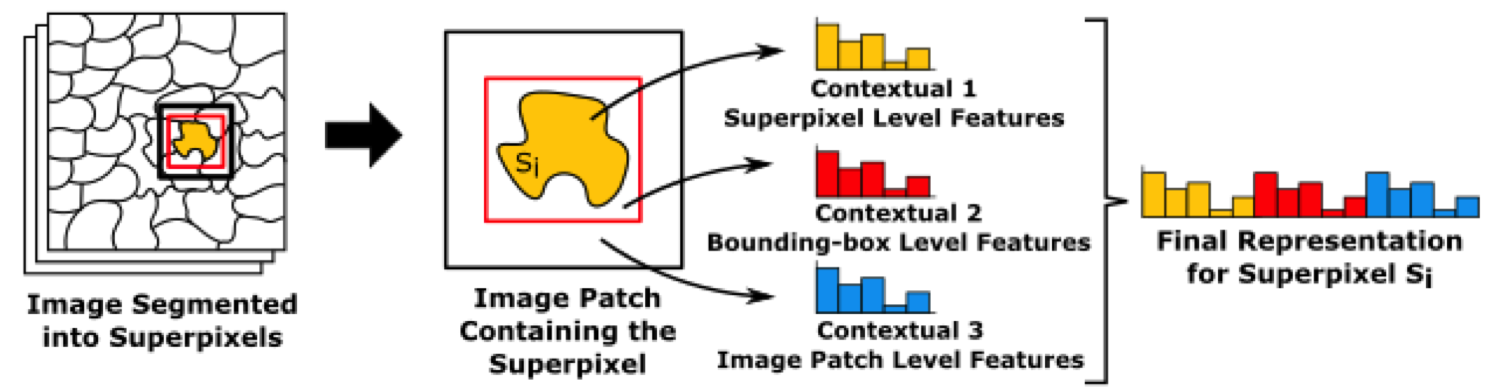
Land-cover maps are one of the main sources of information for studies that support the creation of public policies in areas like urban planning and environmental monitoring. Their automatic creation involves learning to annotate all samples of a Remote Sensing Image (RSI) from just a few annotated by the user. Nevertheless, low-level descriptors like color and shape are not enough to produce a discriminative representation for the samples that represent objects that share similar visual appearance. In order to overcome this limitation, three methods to encode the context of the samples extracted from regions are proposed in this work: the first combines low-level representations from adjacent samples, the second one counts co-occurrences of visual words over a local area and the last one exploits ConvNets to compute deep contextual features. Confirming previous studies, the generated maps were improved by incorporating context in the representations used to feed the classifier.
Some relevant work in this topic are:
[su_spacer]
 |
T. Santana, K. Nogueira, A. M. C. Machado, J. A. dos Santos. Deep Contextual Description of Superpixels for Aerial Urban Scenes Classification. In: International Geoscience & Remote Sensing Symposium (IGARSS 2017), 2017, Fort Worth |
|
T. Santana, A. M. C. Machado, A. A. Araújo., J. A. dos Santos. Star: A Contextual Description of Superpixels for Remote Sensing Image Classification. In: CIARP 2016 – XXI Iberoamerican Congress on Pattern Recognition, 2016, Lima. |
Support contact: Tiago Moreira <tiagohubner10@gmail.com>

A huge effort has been applied in image classification to create high-quality thematic maps and to establish precise inventories about land cover use. The peculiarities of remote sensing images (RSIs) combined with the traditional image classification challenges made RSI classification a hard task. Our aim is to propose a kind of boost-classifier adapted to multiscale segmentation. We use the paradigm of boosting, whose principle is to combine weak classifiers to build an efficient global one. Each weak classifier is trained for one level of the segmentation and one region descriptor. We have proposed and tested weak classifiers based on linear support vector machines (SVM) and region distances provided by descriptors. The experiments were performed on a large image of coffee plantations. We have shown in this paper that our approach based on boosting can detect the scale and set of features best suited to a particular training set. We have also shown that hierarchical multiscale analysis is able to reduce training time and to produce a stronger classifier. We compare the proposed methods with a baseline based on SVM with radial basis function kernel. The results show that the proposed methods outperform the baseline.
Related papers:
[su_spacer]
|
J. A. dos Santos, P-H. Gosselin, S. Phillip-Foliguet, R. da S. Torres, A. X. Falcão. Multiscale Classification of Remote Sensing Images. IEEE Transactions on Geoscience and Remote Sensing, v. 50, p. 3764-3775, 2012 |
|
J. A. dos Santos, P-H. Gosselin, S. Phillip-Foliguet, R. da S. Torres, and A. X. Falcão. Interactive Multiscale Classification of High-Resolution Remote Sensing Images. IEEE Journal of Selected Topics on Earth Observations and Remote Sensing, v. 6, p. 2020-2034, 2013 |
|
J.A. dos Santos, F.A. Faria, R. Torres, A. Rocha, P.H. Gosselin, S. Philipp-Foliguet, A.X. Falcao Descriptor Correlation Analysis for Remote Sensing Image Multi-Scale Classification. In International Conference on Pattern Recognition, Tsukuba Science City, Japan, November 2012 |
|
Almeida, J. A. dos Santos, B. Alberton, R. da S. Torres, and L. P. C. Morellato. Applying Machine Learning based on Multiscale Classifiers to Detect Remote Phenology Patterns in Cerrado Savanna Trees. Ecological Informatics, 2014. |